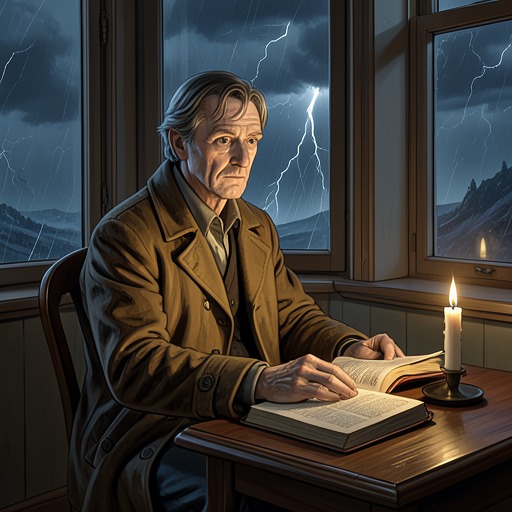
Charley Hoge’s recovered Bible
Butcher's CrossingCharley Hoge’s recovered Bible is both a physical remnant of the expedition’s ordeals and the object through which Hoge clings to faith. Its recovery from the snow makes that attachment visible: the book must be dug out, held carefully, dried page by page, and carried close to his body. Later, its familiar promise of divine protection persists even as Hoge’s memory fails, sharpening the contrast between the object’s endurance and the damage done to the man who depends on it.
Recovery and Use
During the blizzard, Hoge suddenly remembered the Bible and ran from the fire to the large tree where he had kept his belongings. He dropped his cup, struck his chest, and dug frantically in the snow, repeating that he was looking for the book. His search lasted nearly an hour. He repeatedly returned to the fire to warm his remaining hand and bluish stump, then plunged back into the snow, while William Andrews tried to help without knowing where the Bible lay.
Andrews eventually felt a soft mass beneath the snow and found the Bible open, soaked, and spread across ice. He lifted it carefully so its saturated pages would not tear. Hoge took it with a trembling hand and spent the rest of the afternoon and part of the following morning drying it, one page at a time, in front of the fire. In the days that followed, he passed idle hours turning its dirty, stained pages. The book’s material vulnerability—wet paper that could come apart—makes his effort to preserve it as concrete as his reliance on what it represents.
That reliance does not make the Bible an easy instrument of fellowship. When William Andrews, frustrated by the camp’s enforced silence and inactivity, asked Hoge to read aloud, Hoge looked at him angrily and did not answer. Instead, he returned his gaze to the pages, moving his thumb laboriously along each line and concentrating on the text. The gesture shows the Bible as a private practice as well as a religious possession: Hoge keeps reading, but does not offer its words to Andrews on demand.
Faith, Authority, and Memory
The Bible also marks an uneven point of contact between Charley Hoge and William Andrews. When Hoge tried to discuss passages and doubts of interpretation with him, Andrews admitted that he had never read the Bible attentively and knew it too little to discuss it. His father had urged him to read Emerson, not the Bible. Hoge’s eyes clouded with suspicion, and his manner shifted from speaking to Andrews as an equal to preaching at him. For Andrews, the exchange recalled the compulsory morning services at King’s Chapel while he was at Harvard University; yet he felt unexpectedly at home in the rough settlement, and his deepest sense of spiritual freedom had come not from chapel or classroom but from solitude in nature. The Bible thus belongs to Hoge’s faith, while also exposing the different traditions through which the two men approach questions of belief.
At the river crossing, Hoge made that faith part of his decision to take responsibility for guiding the oxen. When the others turned in surprise at his offer, he drew the crooked, stained Bible from inside his shirt and trusted that the Lord would help him and guide his steps. He tucked it back beneath his belt before following Miller toward the crossing. The book was not merely something he read beside the fire: carried against his body, it accompanied him into danger and gave religious meaning to a task he insisted was his to perform.
Later, after the expedition had ended, Hoge’s speech returned to the assurance associated with his faith even as his memory failed him. He told Andrews that Miller was looking for him and spoke as if the men were about to go hunting together again. He remembered Fred Schneider as the skinner Miller had found in Ellsworth, although Schneider was dead. When Andrews tried to make him recognize the loss, Hoge answered gently that nobody died and that the Lord saw and provided. The Bible is not shown in his hands during this exchange; instead, its earlier recovery and close bodily keeping give context to the biblical assurance that survives in his speech. That assurance persists, but it cannot restore the history he has lost.
Faith, Wilderness, and Material Limits
The Bible’s significance is sharpened by the novel’s competing accounts of where spiritual meaning can be found. The opening epigraph invokes Emerson’s Nature, and William Andrews recalls Emerson’s image of the self dissolved into vision: in the woods near Harvard University, he had felt free and connected to God in a way he had not in King’s Chapel or the classroom. Later, at Butcher’s Crossing, he reads the western wilderness as the freedom he is seeking and the expedition as a means—though not the true purpose—of leaving the city behind. Charley Hoge’s book belongs to a different spiritual practice, one grounded in scripture and trust in divine guidance. Their contrast is not simply belief against unbelief: Andrews seeks a revelation in unbounded landscape, while Hoge holds to a sacred text whose words travel with him into danger.
The material outcome of the expedition complicates both forms of faith. J. D. McDonald describes its harvest as a wasted dream: thousands of dead bison, hides left to rot, a ruined wagon, and the memory of a dead man. Against that inventory of irreversible loss, Hoge’s recurring assurance that the Lord sees and provides offers continuity, but not recovery of what has happened or even of Hoge’s own memory. The Bible’s force therefore lies less in explaining the wilderness than in carrying a promise through circumstances that resist explanation. Its survival does not undo the expedition’s damage; it makes the distance between faith’s assurance and the material consequences of the hunt newly visible.
From Text to Refrain
The Bible’s changing role links acts of reading to the limits of memory. In the camp, Charley Hoge laboriously follows its lines but refuses to turn that private attention into a reading for William Andrews. At the river, he draws on the book’s promise of guidance as he accepts the dangerous responsibility of leading the oxen. Later, the assurance that the Lord sees and provides returns in Hoge’s speech, detached from an accurate recollection of the expedition and its dead. Across these moments, the book moves from scripture he handles and reads to a faith-language that persists when his grasp of the past has broken down. Its continuity is real, but incomplete: the words remain available to Hoge, while the events they once accompanied do not.